Five Years, Four Albums: Why We Love The Smiths
In May 1982, Johnny Marr went round to Morrissey's home in Stretford, on the edge of Manchester, to suggest they start a band. By December 1986 they had played their last concert, at Brixton Academy. In between came four studio albums, a stack of singles and a sound that people still reach for decades later.
We make laid-back, jazzy hip-hop out of South Central Los Angeles, so a jangly English guitar band might seem like an odd pick for our blog. But we've been big fans of The Smiths for a long time, and great records travel. Here's a quick tour of their run, album by album, with the pieces from their collection we'd match to each one.
Who were The Smiths?
Four people from Manchester: Morrissey on vocals, Johnny Marr on guitar, Andy Rourke on bass and Mike Joyce on drums, who joined in the autumn of 1982. Their first demo came that August, and their live debut was at Manchester's Ritz that October. Morrissey picked the name, calling it "the most ordinary name", which is half the charm: nothing flashy on the label, everything in the grooves.
They signed to Rough Trade in 1983. The sound is the one everybody describes the same way, because it's true: Marr's ringing, jangling guitar wrapped around Morrissey's lyrics. Andy Rourke, whose bass lines held so much of it together, died in May 2023.
The story is short. Marr left in July 1987, and the band had already split by the time their last album came out that September. Five years, start to finish. We love that kind of focus: say what you came to say, then let the records do the talking.
Where should you start listening?
If you're new, the four studio albums are the whole arc in a weekend:
- The Smiths (1984), the debut, which went to number two in the UK.
- Meat Is Murder (1985), their only UK number one.
- The Queen Is Dead (1986), number two.
- Strangeways, Here We Come (1987), number two, released after the split.
Then there are the compilations, which matter more than compilations usually do: Hatful of Hollow (1984), The World Won't Listen and Louder Than Bombs (both 1987), plus the live album Rank, recorded in 1986 and released in 1988.
And the singles: "This Charming Man", "How Soon Is Now?", "Heaven Knows I'm Miserable Now", "Panic", "Ask", "Bigmouth Strikes Again", "There Is a Light That Never Goes Out". Rolling Stone put four of their albums on its 2012 list of the 500 greatest albums, and "How Soon Is Now?" and "William, It Was Really Nothing" on its 2004 greatest songs list. That's a lot of weight for a band that lasted five years.
Which piece goes with which record?
This is the fun part. The Smiths collection leans on the band's own look: archive photos, album imagery, flowers. Here's how we'd pair them.
Meat Is Murder: the Helmet hoodie. The grainy black-and-white soldier in a battered helmet, with MEAT IS MURDER scrawled across it, is the image behind the 1985 number one. It's stark and direct, and on a three-panel fleece hoodie it's the piece people notice first.
Louder Than Bombs: the deep red portrait. A figure resting their head on a raised hand, all in warm red, with the compilation's title tucked low in the corner. Moody in the best way, and another one on a three-panel fleece hoodie.
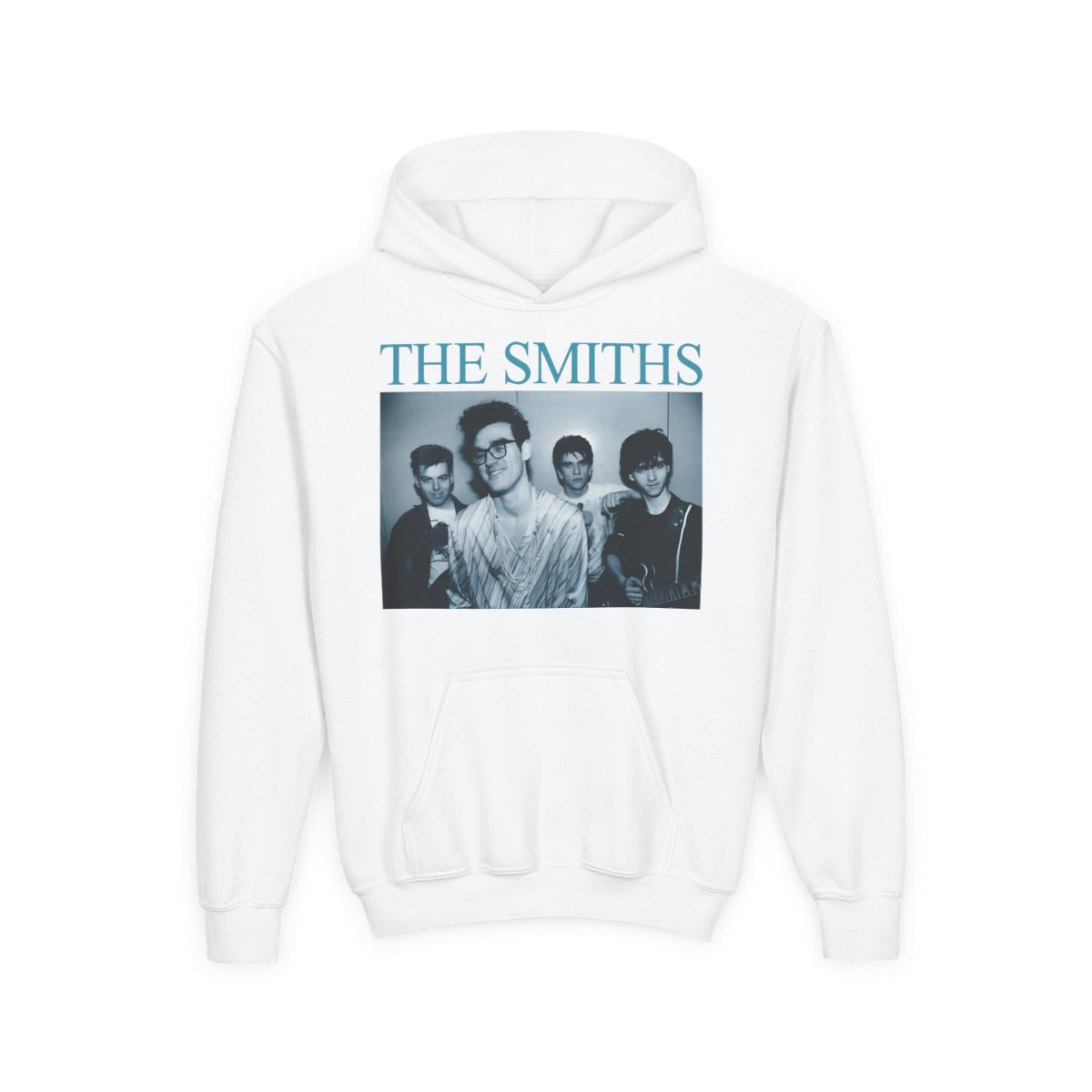
The whole band, any era: the Teal Band Portrait. The four of them in a cool teal photo, one grinning, the others wry, with a guitar neck cutting across the corner. If you want the full line-up in one place, the Teal Band Portrait youth hoodie is the easy answer for a younger listener just finding these records.
The singles: the Gladioli Wordmark. A bunch of red gladioli on green stems with the band's name across it. Flowers are bound up with how people picture The Smiths, and this is one of the cleanest pieces in their range: just colour and a bouquet.
The raw early sound: the Red Smiths Portrait. A grainy red portrait of someone holding a flower to their face, with SMITHS huge across the top. It has the coarse, photocopied feel of an old sleeve and a seven-inch bought on the day it came out.
What if you want something quieter, or louder?
Two designs sit at opposite ends.
The Faded Sepia Trio is the quiet one: three figures in a weathered sepia photo, scratched and stained like a picture found at the back of a drawer, with no lettering at all. It suits anyone who likes the band's mood more than their name on a chest.
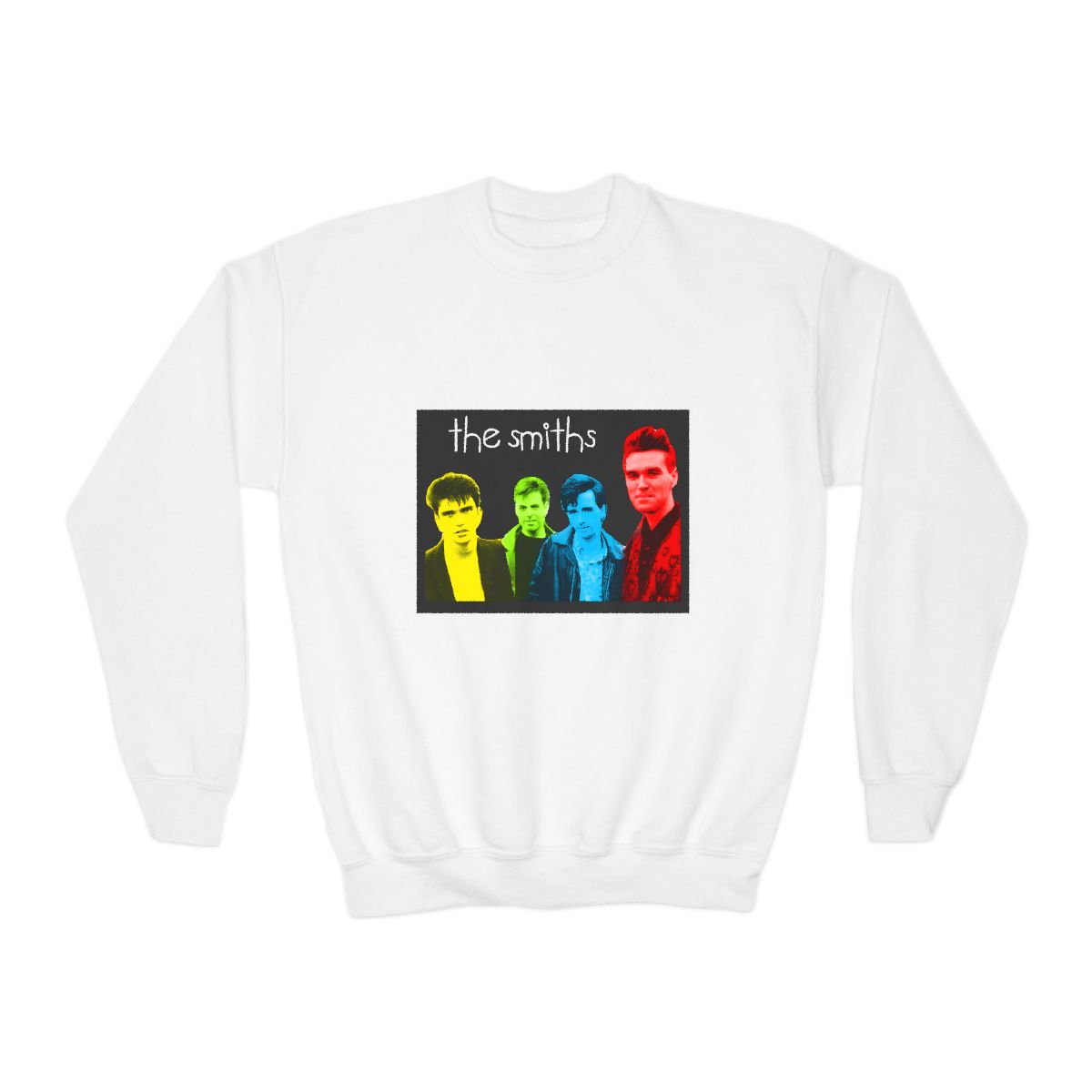
The Pop Colour Portraits is the loud one: four faces in yellow, green, blue and red on black, with the band's name handwritten in white above. It's the most colourful piece in the collection, and it's the one we'd hand to the friend who says The Smiths are too gloomy for them. They aren't, and this proves it.
For dark garments, two pale-toned designs, Design 4 and Design 7, keep things simple and let the colour of the hoodie do the rest.
Why does a hip-hop store care about a Manchester guitar band?
Because good records don't stay in one lane. Our own debut, Bizarre Ride II the Pharcyde, came out on Delicious Vinyl in November 1992; The Smiths built their run on Rough Trade a decade earlier. Different cities, different sounds, same idea: a small label, a crew with a clear voice, and songs that outlast the era they came from.
So if your playlist already runs from "Passin' Me By" to "There Is a Light That Never Goes Out", you're in good company. Pair one of our kids' tees from our shop with a Smiths piece and the youngest music lover in the house is covered for both coasts of their record collection.